
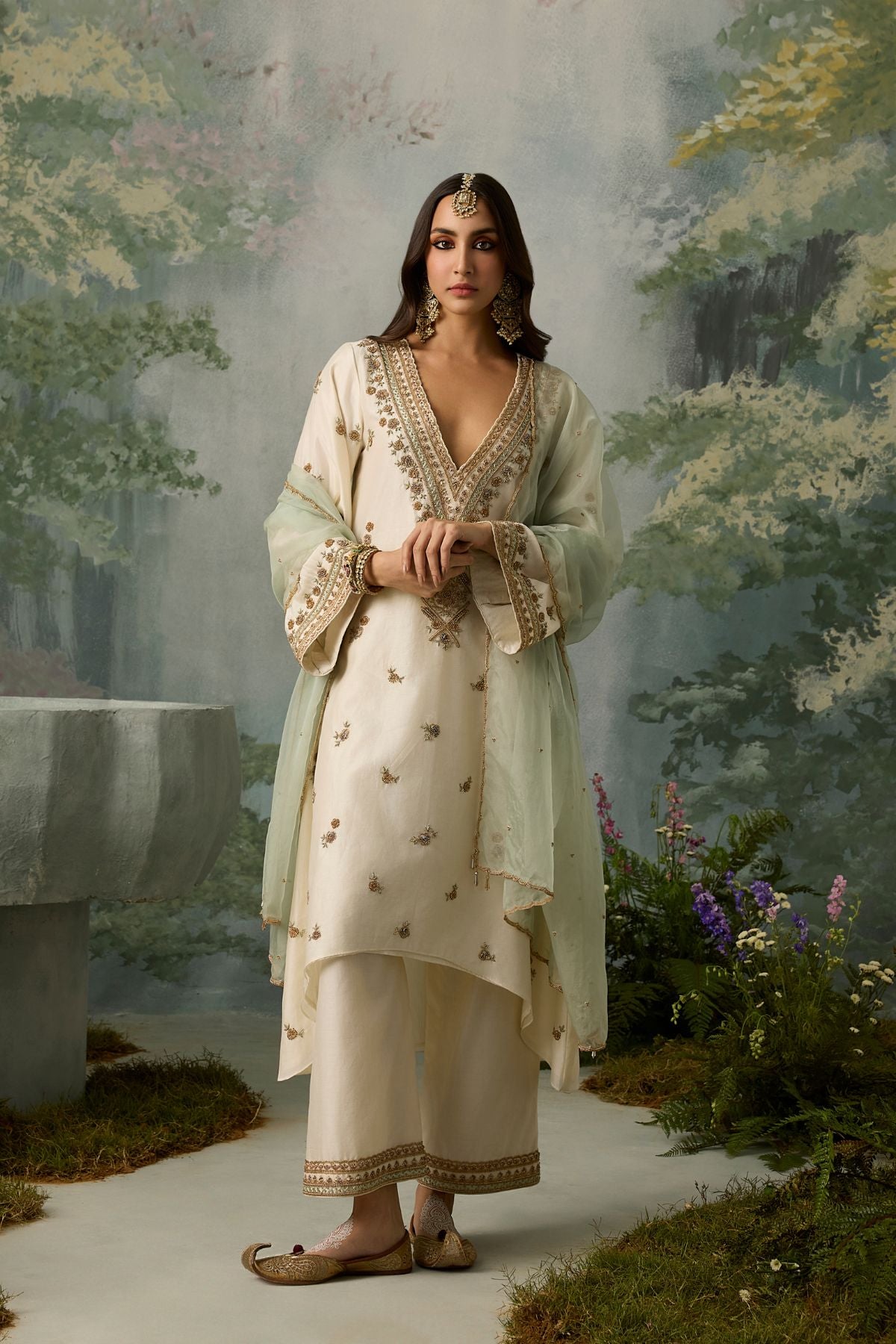
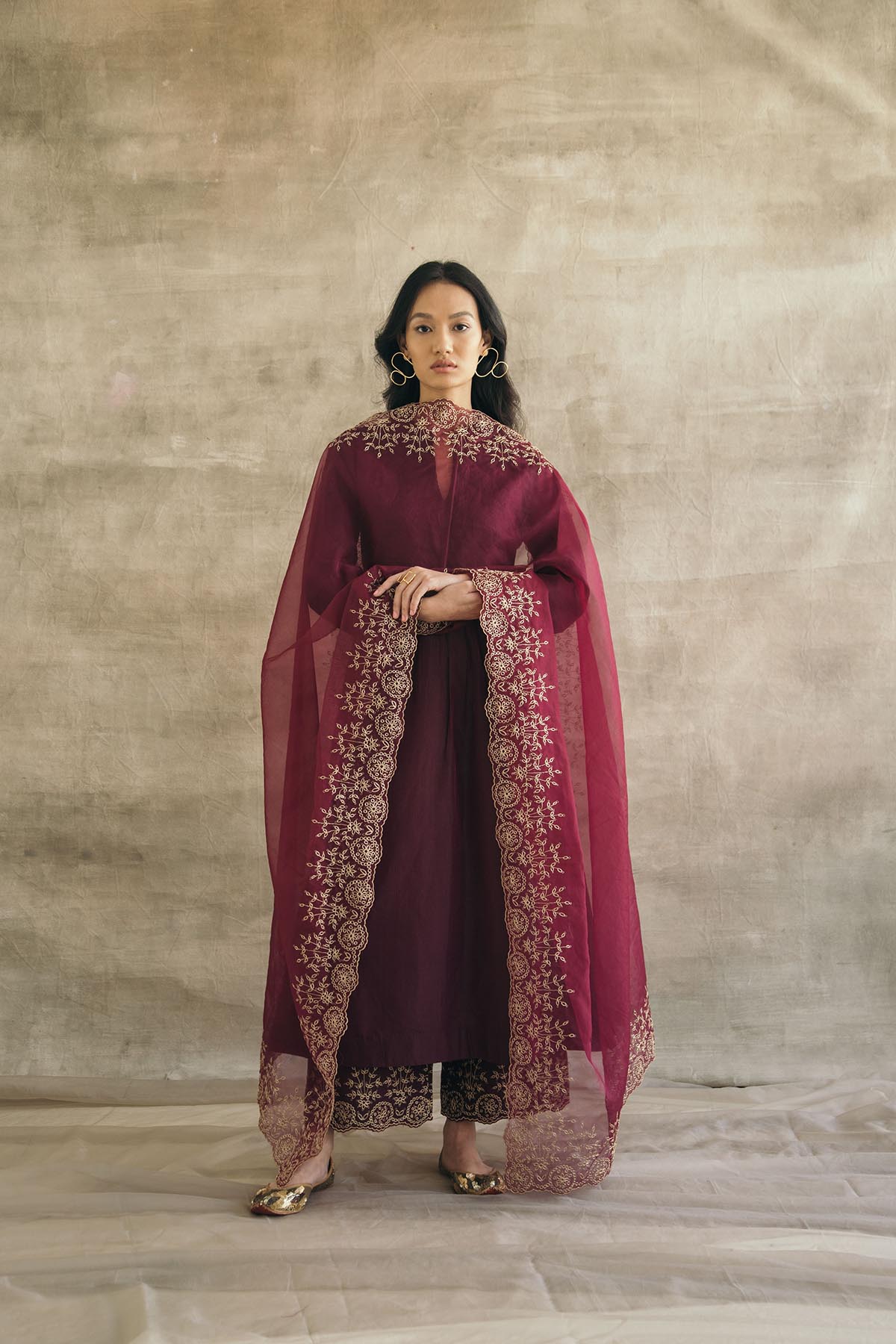
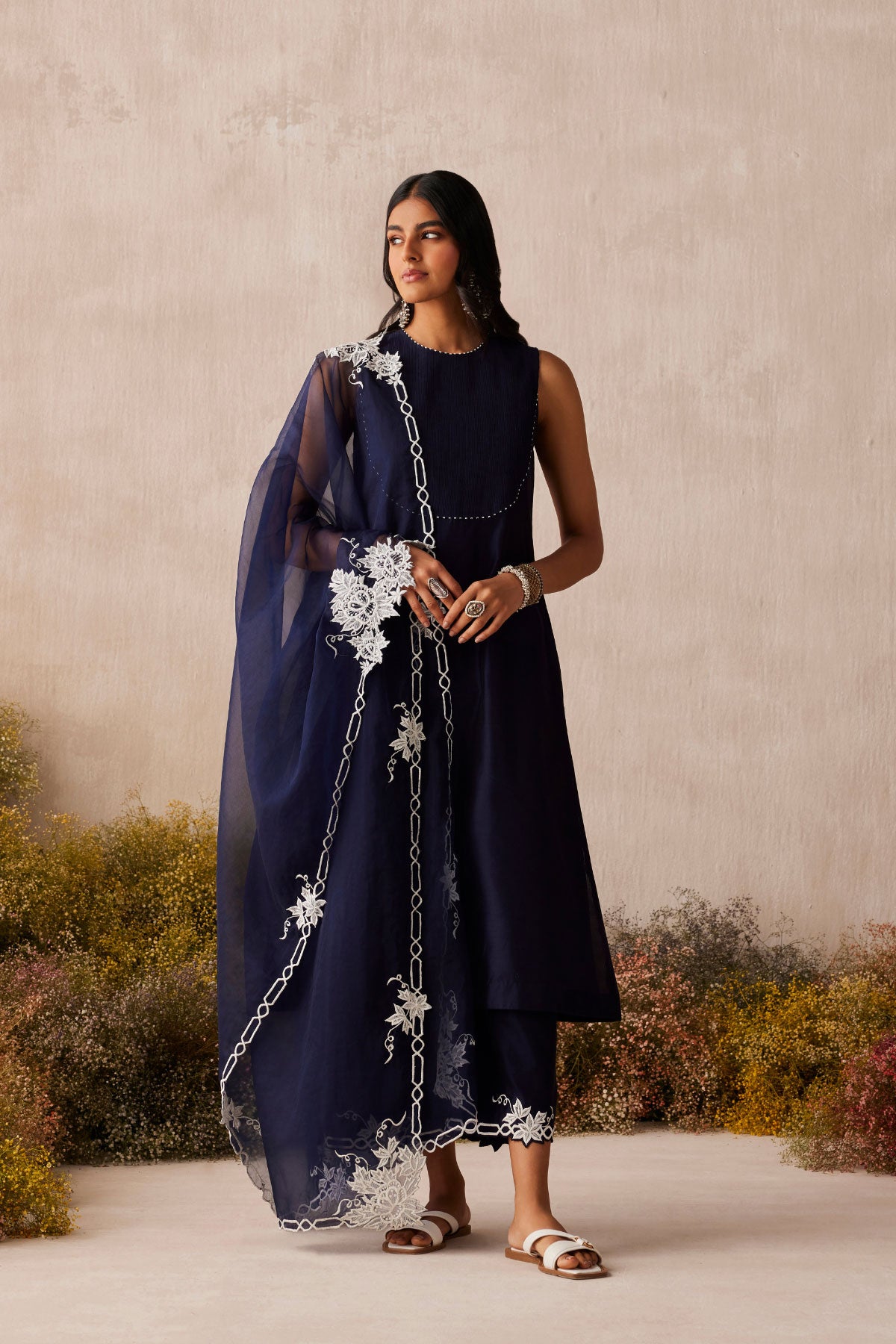
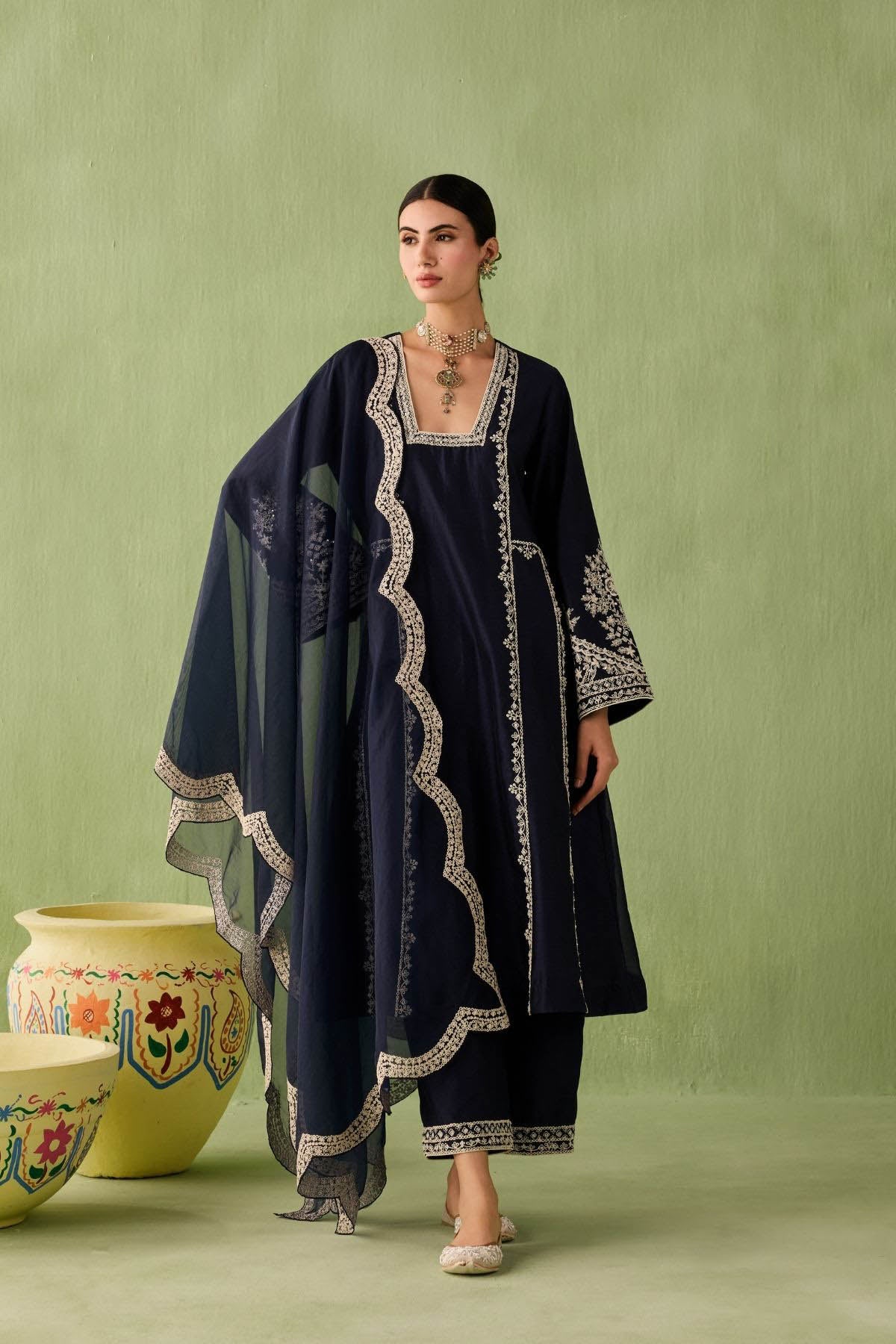


For years, Indian traditional wear has followed a quiet formula: the kurta as everyday staple, the kaftan as vacation ease, the lehenga as festive uniform and so on. Functional, familiar, and often worn the way they’ve always been worn—paired with predictable accessories, styled with little deviation. But at Sureena Chowdhri, tradition has never been about repetition. It has always been about reinterpretation.
What happens when these garments—rooted in history, ritual, and routine—are approached with instinct rather than instruction? When a kurta is thrown over trousers not for modesty, but for sharpness? When a dupatta is draped not with care, but with irreverence? Suddenly, the codes begin to shift. With a rolled sleeve or an unbuttoned neckline, the familiar starts to feel newly expressive.
We’ve come to see traditional wear not as a static category, but as a quiet language—one that reveals something about the person wearing it. Not just where they’re from, but how they see themselves. The result is a study in restraint and reinvention. A belief that clothes don’t need to shout to say something meaningful.

Our experiments in the field of traditional wear continue—with Phalguni Guliani as our latest muse. A curator (or more precisely, an exhibition-maker), Phalguni’s studio is part archive, part sanctuary—where shelves brim with evidence of material memory: found photographs, porcelain figurines, posters, and fragments of books. Together, they form an evolving installation of her inner world—an almost accidental exhibition of her own life, curated over time with instinct and care. These objects don’t just decorate the space; they narrate it. And in response, we styled looks that reflected that same sensibility—layered, intuitive, and quietly personal.
We took two of our house favourites—the Midnight Cool Kurta Set and the Ebony & Ivory Kaftan—and reimagined them on Phalguni, not as finished garments, but as starting points. Pieces that could be moulded to reflect the person wearing them.
Look 1: The Kurta, Pushing Boundaries
On the surface, the Midnight Cool Kurta Set plays by the rules. A sleeveless silk chanderi ensemble in a nude beige—light enough for balmy summer nights, refined enough to carry from day into evening. The kurta’s yoke is elevated with narrow pin tucks, while the bottoms taper into scalloped, geometric hems. A sheer organza dupatta, scattered with abstract floral appliqué, completes the look.
But we wanted to push it further.

On Phalguni, the set’s quiet neutrality became a springboard. We styled the dupatta as a loosely knotted scarf. Swapped traditional footwear for mesh Alaïa ballet flats. Finished the look with a deep red lip. The result? A study in restraint and rebellion. A reminder that even the most classic silhouette can carry a sharp point of view—when you let it.
Look 2: The Kaftan, A Canvas
Our Ebony and Ivory Kaftan is known for its restraint. Crafted in featherlight muslin, it falls from shoulder to ankle in uninterrupted ivory, punctuated only by a plunging neckline and a bold black appliqué panel that traces the sides. The yoke—delicately embroidered in tonal threadwork—grounds the look in a kind of quiet elegance, making it a perennial go-to for resort evenings and city escapes alike.
But what happens when you take something monochrome—and use it to introduce colour?

For this look, we decided to break the rules. We styled Phalguni with high-shine neon green stockings and matching heels—a jolt of colour that felt both jarring and just right. Her makeup took on a sculptural edge with a graphic liner, and her bangs—newly added for the shoot—created a sharpness that contrasted the kaftan’s fluidity.
The most unexpected detail? A pair of DIY pea pod earrings. Real pea shells, polished and hollowed, filled with tiny pearls in place of peas. Delicate, absurd, and oddly elegant—they echoed Phalguni’s space perfectly.
Set against the backdrop of her studio—where art books leaned against ceramic cats and vintage furniture stood beside stacks of postcards, textiles, and other found things—the look felt less like a fashion statement and more like a mood board come to life.

In the end, this wasn’t just about styling clothes—it was about shifting context. About taking garments rooted in tradition and placing them in a space that’s deeply personal, even a little unpredictable. With Phalguni as muse, the kurta and the kaftan stepped outside the roles they’ve long been assigned. They became softer, sharper, stranger—shaped as much by their wearer as by their design. And perhaps that’s the point. Tradition doesn’t need to be rewritten. But it does need room to move.


